What Makes DuPont™ Kevlar® Fibers an Ideal Material for Hurricane Screens
When people think about hurricane protection, they tend to think about shutters, impact windows, and reinforced doors. Exterior screens are a more recent addition to that conversation, and the material they are made from is a big part of what makes the best of them capable of standing up to the same conditions those other products are designed for.
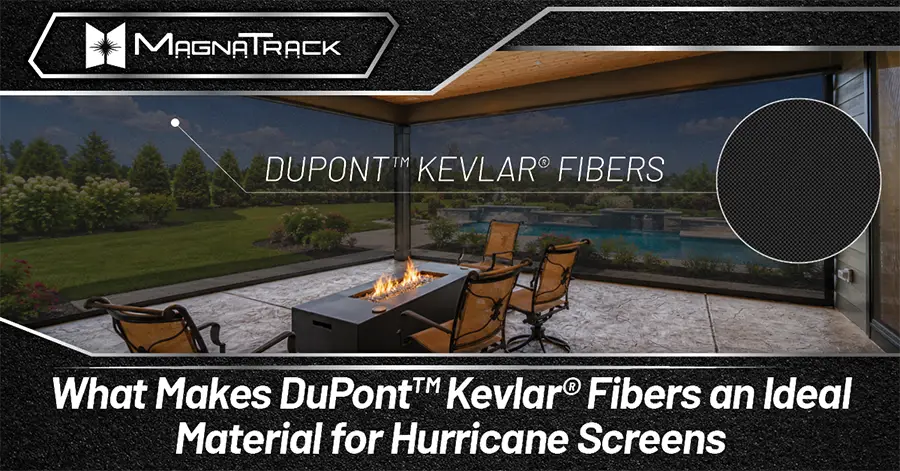
The MagnaTrack Defender Hurricane Screen uses a fabric constructed from genuine DuPont™ Kevlar® fibers. Understanding what that means, and why it matters for a product designed to withstand Category 5 winds at 157 mph and flying debris, helps explain why not all hurricane screens perform equally.
What DuPont Kevlar Fibers Are
Kevlar is a brand name for a specific type of para-aramid synthetic fiber developed by chemists at DuPont in the 1960s and first commercially introduced in the early 1970s. Para-aramid fibers are a class of heat-resistant, high-strength synthetic materials known for their extraordinary tensile strength relative to their weight.
What makes DuPont Kevlar fibers exceptional is their molecular structure. The polymer chains are oriented parallel to the fiber axis, which gives the material its characteristic combination of:
- • High tensile strength that resists tearing and puncture under extreme force
- • Low weight relative to strength, making it practical as a retractable screen fabric
- • Resistance to elongation under load, so the fabric holds its shape under sustained wind pressure
- • Heat resistance up to 800 degrees Fahrenheit, which maintains performance across a wide range of environmental conditions
These properties are what make DuPont Kevlar fibers the material of choice in applications where failure is not an option, including:
- • Ballistic body armor
- • Aerospace components
- • Cut-resistant industrial gloves
- • Reinforced cables and structural applications
- • Exterior hurricane screens
Why Tensile Strength Matters in a Hurricane
During a hurricane, a screen faces two distinct types of force. The first is sustained wind pressure, which pushes against the screen continuously for the duration of the storm. The second is impact from wind-borne debris, which is sudden, concentrated, and unpredictable.
Standard screen fabrics, whether used in pool cages, patio enclosures, or budget hurricane screens, are typically made from polyester or fiberglass. Under extreme wind pressure and debris impact, they fail in predictable ways:
- • Tearing at stress concentrations along the fabric edge
- • Pulling out of their frames under sustained wind load
- • Puncturing on impact from wind-borne debris
DuPont Kevlar fibers behave differently under the same conditions. The material absorbs energy across the woven structure rather than concentrating it at a single point, which is why it can take an impact that would punch through a standard screen and redistribute that force without failing.
How the Weave Amplifies the Material’s Strength
The performance of a DuPont Kevlar fabric is about the fiber itself, but also how that fiber is woven into the final material.
A woven construction interlocks the fibers in both the horizontal and vertical directions, creating a structure where force applied to any single point is immediately shared across the surrounding fibers in multiple directions. The result is a fabric that:
- • Distributes impact energy outward from the point of contact rather than concentrating it
- • Resists tear propagation once a stress point is established
- • Maintains structural integrity under the dynamic, unpredictable conditions of a real hurricane
This is the same principle that makes woven Kevlar fabrics effective in body armor applications, scaled and adapted for an exterior building product.
Strength Without Sacrificing Visibility
One of the practical challenges in designing a hurricane screen is balancing protection with livability. DuPont Kevlar fibers are inherently lightweight relative to their strength, which allows the Defender fabric to be engineered to meet extreme performance standards without the thickness or opacity that would otherwise be required.
In practical terms, this means:
- • The screen allows visibility and airflow when deployed under normal conditions
- • It does not feel closed in or oppressive during everyday use
- • The protection is built into the fiber, not achieved through bulk or opacity
That’s what CAT-5 protection with a view actually means in material terms.
How This Compares to Standard Hurricane Screen Materials
Not every product marketed as a hurricane screen uses the same materials. The distinction matters because wind resistance and debris impact resistance are not the same thing. A fabric can be rated for high wind loads while still failing under a point impact from a fast-moving piece of debris.
The ASTM E1996 large missile impact test, which the Defender passes, requires the fabric to withstand the impact of a nine-pound two-by-four lumber missile. Passing this test requires a material that can:
- • Absorb sudden, concentrated impact force without puncturing
- • Maintain retention in the track under the dynamic pressure that follows impact
- • Perform consistently across repeated test cycles without degrading
DuPont Kevlar fibers are one of the few materials that can meet that standard in a fabric format thin enough to be practical as a retractable exterior screen.
The Defender also carries the following independent certifications:
- • TAS 201, 202, and 203 Florida test protocols for impact resistance and pressure cycling
- • ASTM E330 for uniform static air pressure
- • ASTM E1886 and E1996 for wind-borne debris impact resistance
- • Florida Product Approval FL30798 with design pressure up to 200 PSF
- • Rated for Category 5 winds at 157 mph and above
Protection Starts With What the Screen Is Made Of
The material a hurricane screen is made from is the primary determinant of how the screen performs when the conditions it was designed for actually arrive. DuPont Kevlar fibers bring a category of strength and impact resistance to exterior screen applications that standard fabrics cannot match, and the MagnaTrack Defender’s certifications reflect what that material is capable of under real test conditions.
If you want to find out whether the Defender is right for your space, fill out the form to connect with a local MagnaTrack dealer and get your free quote.